Algeria's Defence Sector Signals Shift as Tebboune Declares End to Spare Parts Imports
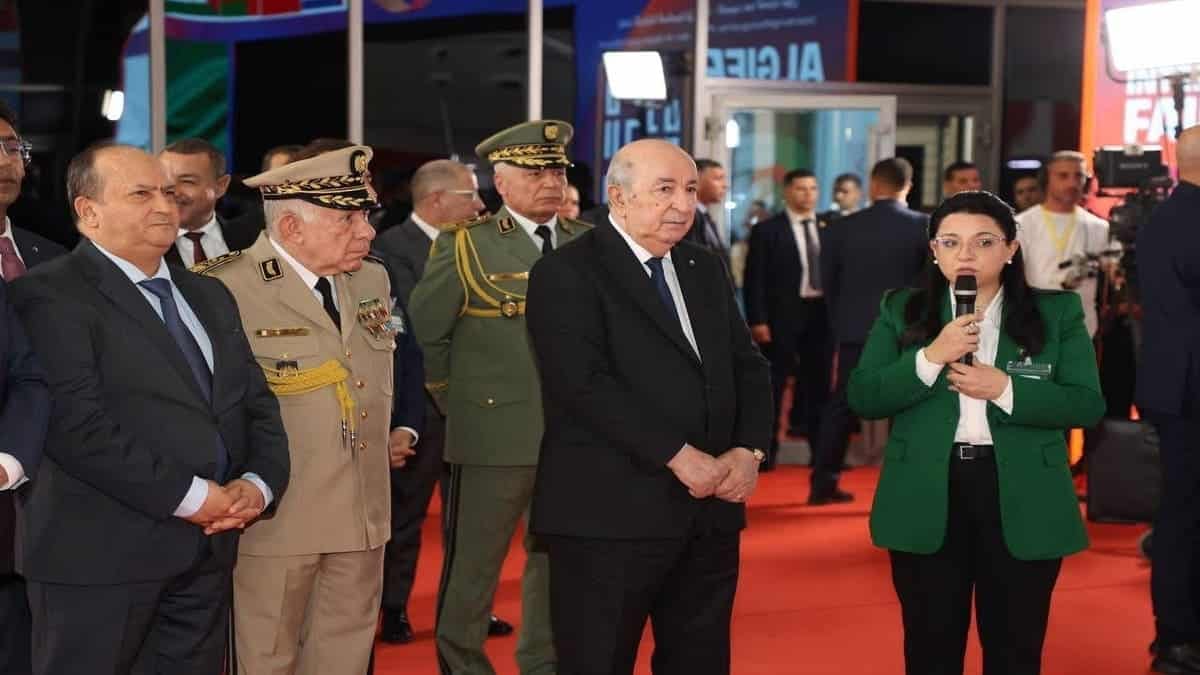
ALGIERS, Algeria - Algeria's defence manufacturing base and civilian industrial capacity are now the stated justification for a sweeping import substitution push, after President Abdelmadjid Tebboune declared at the 57th International Fair of Algiers (FIA) that the country "should no longer import spare parts" - a statement carrying direct implications for procurement policy and the country's current account position.
Speaking on Thursday, June 22, at the Salon des Expositions in Algiers, Tebboune inaugurated the FIA under this year's theme: "Confidence and stability for sustainable growth." Spain, whose economic ties with Algeria recovered sharply following the 2022–2023 diplomatic rupture, serves as the edition's guest of honour - a signal that Algiers is selectively re-opening bilateral trade channels even as it tightens domestic sourcing requirements.
The president's most pointed remarks came during his visit to the MDN pavilion, where he examined domestically produced military equipment, including handling a "100% Algerian" automatic pistol. "In principle, a country that reaches such a level, whether in military or civilian industries or in startups, no longer has the right to import spare parts, except for truly very technical parts," Tebboune said. He added: "We have engineers, we train thousands of engineers each year - it is time to give them the opportunity to express themselves for the national economy."
The statement is not a formal regulatory decree, and details of any implementing legislation remain unconfirmed. But as a directive from the head of state at Algeria's most prominent annual trade forum, the message carries operational weight for both public procurement bodies and private-sector operators dependent on imported components.
The immediate exposure lies in import-dependent sectors - automotive assembly, heavy equipment maintenance, oil and gas servicing, and public utilities - where spare parts sourcing from foreign suppliers has historically been the default. With Algeria running a current account deficit of -1.0% of GDP in 2024, and hydrocarbon export revenues constrained by Brent crude at $76.8 per barrel, the fiscal logic behind domestic substitution is straightforward: reduce the outflow on goods that, by the president's assessment, Algerian industry and engineering talent can now produce.
Algeria posted GDP growth of 3.7% in 2024, with the IMF projecting 3.8% for 2026 and 2.9% for 2027. Exports account for 19.9% of GDP - a figure heavily weighted toward hydrocarbons - while inflation runs at 4.0% and unemployment stands at 11.6% as of 2025. Against that backdrop, the spare parts directive functions as both an industrial policy signal and an employment lever: redirecting demand toward domestic manufacturers would, in theory, absorb engineering graduates entering an 11.6% unemployment market.
For operators in defence supply chains and dual-use industrial manufacturing, the MDN's expanded domestic production capability - on display at the FIA - positions the state-led industrial base as the reference model for the civilian economy. How quickly procurement rules are amended to enforce local sourcing, and whether carve-outs for "truly very technical" components are defined narrowly or broadly, will determine the effective scope of the policy.
For institutional investors assessing Algeria's investment climate, the key risk is policy sequencing: aggressive import substitution without a parallel build-out of quality-certified local suppliers can produce supply disruptions and cost inflation, particularly in energy-sector maintenance where equipment reliability is non-negotiable. The FIA statement sets a direction; the regulatory architecture to support it has yet to be confirmed